
Ottawa County Current Owner Fields on the Roll
Ottawa County keeps the roll name you need. The county offers two official routes. The Ottawa County Appraiser public portal promotes owner-name and address access, though parts of it demand a login before anything displays. The Treasurer search is the steadier option. It separates Current Owner from Taxpayer, and that distinction matters because the party paying an Ottawa County tax bill is not always the parcel's owner of record.
| Roll field | What to preserve |
|---|---|
| Owner name | The exact person, trust, estate, or entity spelling returned |
| Mailing address | The destination for notices, which can be outside Ottawa County |
| Situs address | The physical property location, when one is assigned |
| CAMA or tax ID | The account key used to separate similar names |
| Legal description | Lot, block and addition, or section, township and range |
| Tax year/status | The roll year and account context attached to the result |
Not every parcel card looks alike. An Ottawa County result may omit the last-sale date and any deed reference, so trust only what the screen shows. Then take the parcel key and legal description forward into the newer property records.
Check Ottawa County's Current Owner and Taxpayer Labels
The Ottawa County Treasurer search accepts an owner or taxpayer name and lets you pick Current Owner, Taxpayer, or Both. Begin with a last name or exact entity name. Add Real Estate as the tax type. If the list runs long, narrow it with street number, street name, subdivision, or tax year.
A taxpayer match shows who handles the bill. It is not automatically the owner. The paying party may manage correspondence for an Ottawa County property without holding title. When the labels differ, keep both names, the tax year, and the CAMA or tax ID. Then ask the Appraiser which roll entry governs.
Note: The Treasurer database posts a September 7, 2026 update notice, but that date alone does not prove same-day deed-to-roll posting.
Ottawa County Roll Timing and the Recent-Sale Gap
The Ottawa County Appraiser discovers, lists, and appraises taxable property. Each parcel gets a new value every year. A physical visit follows once every six years. Those cycles describe assessment work, not instant title updates, so a deed can be recorded while an Ottawa County roll screen still carries the prior owner's name.
The Appraiser site posts a database update dated September 4, 2026. That marker reflects the site as a whole. It says nothing about one parcel. After a closing, compare the instrument recording date with the roll year and the posted update note before trusting either record alone.
Recent-sale check. The roll can lag a transfer. The newest recorded deed is the stronger current-owner clue when its legal description matches the parcel.
Verify the Current Ottawa County Owner Against the Deed
This check stays narrow. You are confirming the present record, not rebuilding a full Ottawa County ownership history. Use the roll to fix the parcel. Then compare that parcel with the latest conveyance in the Register of Deeds deed records.
- Record the owner label, CAMA or tax ID, situs address, and full legal description.
- Open the Ottawa County Register of Deeds page and use its named Laredo or Tapestry access, or contact the office.
- Search the roll name as grantee and compare the deed's legal description.
- Confirm that no later deed transferred the same tract to another grantee.
- When online coverage is unclear, request the latest matching instrument in person.
- Owner of record
- The party named on the active assessment or tax roll.
- Assessment roll
- The county property listing used for appraisal and tax administration.
- Situs address
- The property's physical location, distinct from its notice address.
- Recording lag
- The interval before a recorded transfer appears in another system.
When an Ottawa County Mailing Address Differs
A mailing address tells the county where notices go. It does not prove the owner lives there. The addressee could be an out-of-county owner, a trust administrator, an estate representative, or a business office handling tax mail for the Ottawa County property. The situs address identifies the land itself. The CAMA key or legal description keeps every record tied to the right parcel. Use the mailing address only for lawful property correspondence. A difference between the two addresses is common, and it is not an error by itself.
Ottawa County Current Owner Names Held by an Entity
An Ottawa County roll does not always name a person. Sometimes the owner of record is an entity. LLCs, corporations, trusts, estates, and joint owners all appear. Copy the name exactly. Punctuation and suffixes can separate entities. For a Kansas business, the Secretary of State Business Entity Search takes an entity name or business ID and may surface a resident agent.
A resident agent is a statutory contact. That agent is not automatically the beneficial owner of the land. Trust and estate names may require the recorded deed or a public probate filing to explain who holds what capacity. The latest deed's grantee line remains the key comparison for current ownership of the Ottawa County parcel.
Note: Search exact and partial name variants when initials, "et al.," trustee language, or abbreviations hide a valid roll record.
Annual Ottawa County Values Do Not Retitle Land
Ottawa County sets a new value on every parcel each year and mails valuation notices around April 1. That annual act changes appraisal data. It does not convey ownership. The six-year physical cycle likewise concerns inspection and listing, never vesting. Value work and title work are different jobs. The official Ottawa County Appraiser page shows the office location and the assessment guidance behind this distinction.
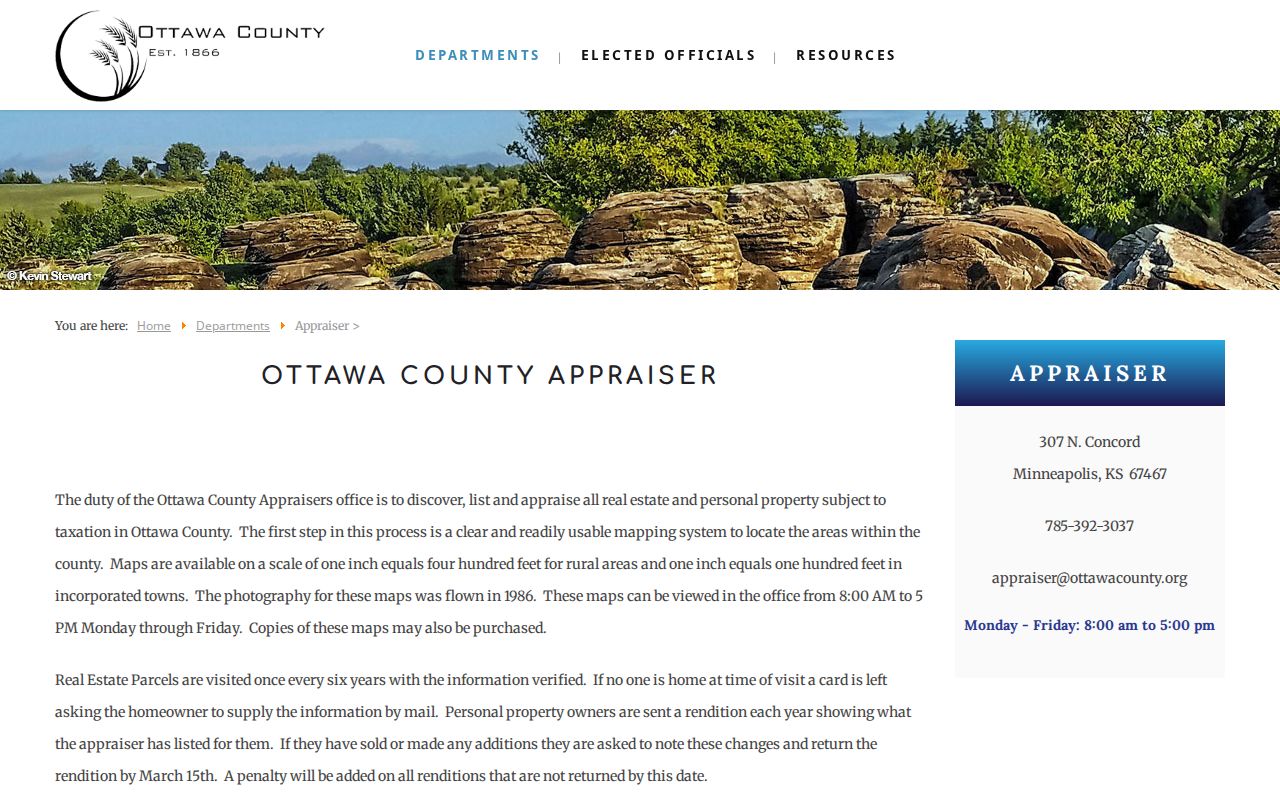
The Appraiser's official page doubles as the follow-up stop. It carries the office details and assessment guidance a parcel question might need. That separation explains a common puzzle. An Ottawa County appraisal record can be fresh for value work while still needing a deed check for a recent owner. Value fields answer one question. Ownership turns on the roll name and the recorded deed, and readers who want the value side can start with the Ottawa County property value guide.
Protected Addresses in Ottawa County Owner Records
Public land records do not automatically expose every personal detail. Kansas draws that line deliberately. The Kansas Safe at Home program gives eligible victims a substitute address along with mail forwarding. That protection depends on secrecy. Nobody should try to reverse engineer a shielded address. Piecing together clues from other records defeats the purpose. The Kansas Open Records Act permits certain exceptions beside its access rules. A redacted field is lawful rather than an error. Ask the custodian for whatever portion is public and let the rest stay private.
Ownership verification is still the legitimate aim. Someone tracing an Ottawa County parcel may need to resolve a deed question, settle a boundary dispute, or address proper correspondence to the owner of record. Those goals work fine within the redaction rules.
Separate Ottawa County's Owner from Its Occupant
Ottawa County land records answer one question: who holds title. They do not answer who lives there. The owner of record, the taxpayer on the tax roll, the mailing contact, and the person actually present at an address can all be different people. Each record serves a distinct purpose.
The gap widens with farms, vacant parcels, business tracts, estates, and trust-held property. County systems track parcels, valuation, taxes, and recorded instruments rather than occupants. So describe any result carefully. Name the owner of record for the stated roll year. Then point to the latest matching deed in the deed records whenever a transfer needs confirmation.
Use Ottawa County Current Owner Data Lawfully
When a portal comes up short, the county still opens other doors. You can visit the Appraiser or Register of Deeds counter at 307 N. Concord in Minneapolis, call the Appraiser at 785-392-3037, or file a focused request under the Kansas Open Records Act. Bring the parcel ID, legal description, names, and date range. That detail lets staff pull the right public record without any title-search duty falling on them.
The Register of Deeds safeguards permanent land records. Most are open to the public during regular business hours. The office does not perform title searches or give legal advice, though. For a title opinion, a licensed title company or attorney is the proper source.
Lawful use. Use current owner data for legitimate property research, due diligence, estate work, or civic questions. Harassment, intimidation, or targeting is prohibited.