
Fields Inside Ottawa County Property Tax Records
Ottawa County property tax records split their duties between two offices. The Appraiser finds, lists, and values taxable property across the county. The Treasurer keeps the billing side. The public property search there offers account details and tax-year controls. It also filters by unpaid balance. Read these fields together. A statement amount is never the same as a parcel's full appraised value.
| Field | What It Shows | Where |
|---|---|---|
| Appraised value | County estimate of fair-market value | Ottawa County Appraiser |
| Assessed value | Appraised value after the Kansas class rate is applied | Ottawa County Appraiser |
| Tax year and account | Year, unit, parcel, CAMA, and quick-reference keys | Ottawa County Treasurer |
| Bill and status | Current or delinquent taxes and payment history | Ottawa County Treasurer |
| Levy sources | City, township, school, county, and other taxing-authority levies | County Clerk levy sheets |
Kansas turns appraised value into assessed value through a class rate. The mill levy then applies to that assessed amount. A residential parcel follows the Kansas residential class rate, while commercial, vacant, and agricultural property each follow separate rules. The resulting tax is not a sale price. It is not a private appraisal either.
Ottawa County Tax Search Keys Go Beyond an Address
The free Ottawa County Treasurer tax search opens a wide set of local fields. Start with the keys you know. Then narrow the results. For a name lookup, the portal suggests beginning with a last name alone.
| Search control | Accepted clue | Best use |
|---|---|---|
| Owner or taxpayer | Name up to 30 characters; Current Owner, Taxpayer, or Both | Separate the roll owner from the person or service paying tax |
| Property address | Street number and street name | Find a known situs address |
| CAMA number | Eight preserved segments | Return to an exact assessment account |
| Platted description | Subdivision, block, and lot | Search city lots and additions |
| Rural description | Section, township, and range | Search land outside a recorded city plat |
| Tax filters | Year range, current taxes, or taxes due | Focus on a billing period or delinquency |
Additional controls include tax type, Unit and Parcel identifiers, Lease Name, and Quick Ref. The page labels Street Direction and ZIP, though those controls may not function. Treat those values as optional. City parcels narrow further through the portal's long subdivision list. It holds original-town and named-addition entries for Minneapolis, Bennington, and Delphos. Rural and historic place names appear there too. Copy the displayed spelling exactly, even where text is truncated. That spelling is the county's real search vocabulary. For unplatted rural land, pair section, township, and range with the address.
Ottawa County's Property Tax Calendar Has Two Tracks
The value track starts with the Appraiser. Each parcel gets a new value every year. Physical verification happens once in each six-year cycle. Notices go out around April 1. The bill track runs later, since the Treasurer mails statements in early November. Full payment or the first half comes due December 20. The second half is due May 10 of the following year, and no second statement goes out for it. Those deadlines show why a property search should name its tax year and current status.
The 2026 Ottawa County Market Study Behind New Values
The Ottawa County Appraiser issued 2026 trend guidance. It was tuned to local property rather than one blanket change. Homes older stock trended at 5 percent. Newer homes came in at 7 percent. Commercial property came in at 4 percent, and vacant lots held stable. These figures are study signals, not automatic values for any single parcel. Location, age, style, condition, corrections, and comparable sales can each move an individual result. Keep the parcel notice. Gather photos, repair estimates, and recent comparable sales if the displayed appraisal looks wrong.
How to Pull an Ottawa County Tax Bill
Begin with the Treasurer search when you need a bill, payment status, or delinquency. That workflow keeps the parcel tied to the right tax year. It also keeps an owner name from being mistaken for a taxpayer name.
- Select Real Estate, then search by address, parcel, CAMA number, owner, or legal description.
- Match the situs and legal description, then copy the tax unit, parcel key, and tax year.
- Read the statement and payment status, checking prior years separately when needed.
- Compare the value with the Appraiser record and note any protest or delinquency issue.
- Assessed value
- The appraised amount after the statutory class percentage is applied.
- Mill levy
- The rate applied per thousand dollars of assessed value.
- Homestead refund
- A separate Kansas refund route for eligible taxpayers; the County Clerk can assist with local questions.
- Tax lien
- The county's claim arising from unpaid real-estate tax.
What the Ottawa County Tax Form Looks Like
The Treasurer search screen displays many matching fields at once. A parcel number or legal description often works better than a broad name.
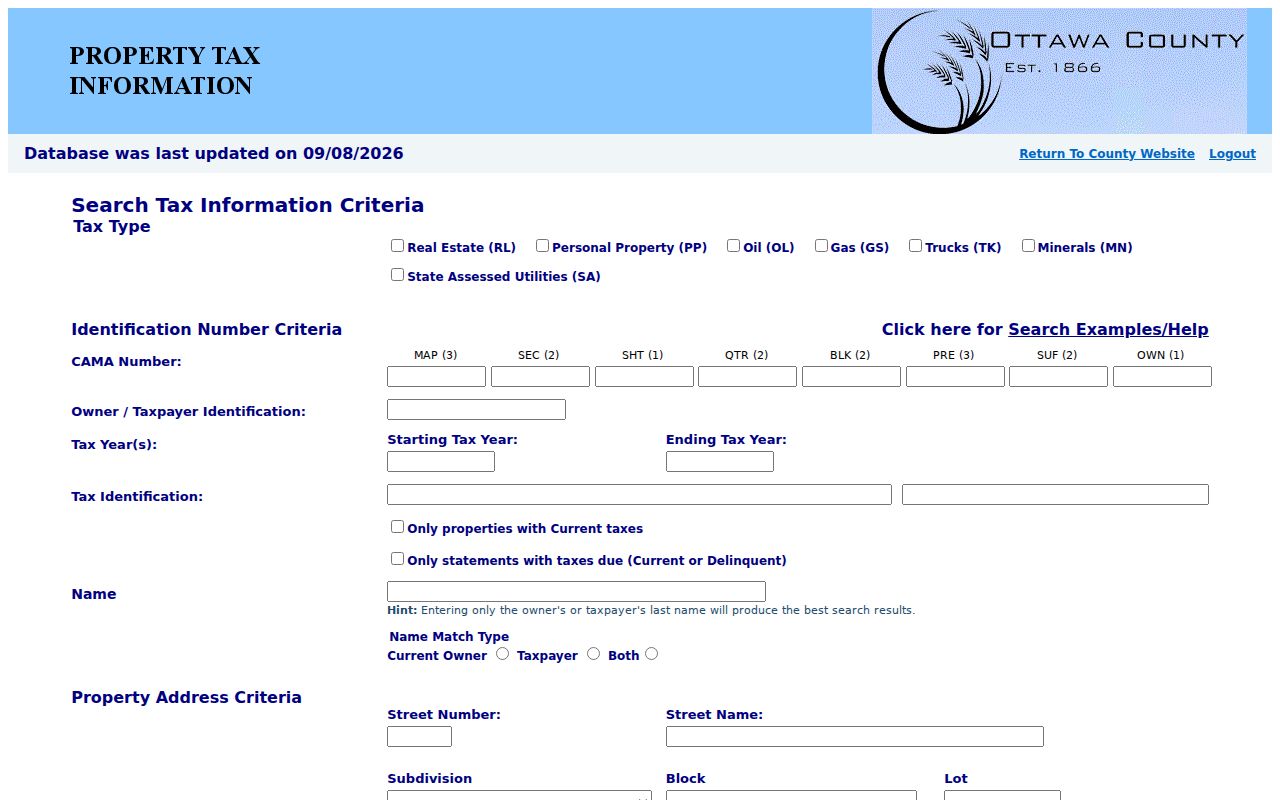
Those controls let a researcher move from a city lot and block to a rural section, township, and range. Everything stays inside the official county system.
When Ottawa County Property Tax Becomes Delinquent
Interest attaches once a deadline is missed. The Treasurer reports that unpaid real estate gets published three times in August. Land delinquent for three years may qualify for a tax foreclosure sale. Eligibility alone does not prove a sale was ordered. Run the taxes-due filter first. Then contact the Treasurer for the live balance and status. Court records can add foreclosure filings. But the Treasurer remains the authority on the county tax account. Online access is only one channel. A searcher can call the Treasurer for a current balance, ask the Appraiser about value or class, or inspect county records in person. A searcher can also file a focused Kansas Open Records Act request for an identified record. Name the parcel key, the tax year, and the document sought. Say whether inspection or a copy is needed. The Act does not require staff to build a new report.
Ottawa County Levy Sheets Explain the Rate
The County Clerk keeps the official levy-sheet archive. Annual sheets run from 2014 through 2025. These deed and tax records show the county, city, township, school, and other taxing-authority rates behind each bill. A levy sheet explains the rate. It does not replace the parcel statement. Match the year and taxing units on the property tax record before comparing totals across years.
Contesting an Ottawa County Property Assessment
An owner can request an informal meeting with the Ottawa County Appraiser. The meeting can happen once the valuation notice arrives. The dispute targets appraised value and classification. A dislike of the final tax total is not enough. Strong evidence includes recent sales, photographs, repair estimates, and comparable-property facts.
Appeal window. Ottawa County gives 30 days from the valuation notice to appeal; later payment-under-protest routes have separate deadlines.
A protest starts with a meeting. Sit down with the county Appraiser to review the current year's assessment before anything else. From there, one appeal route is allowed per tax year in Kansas. So choose it carefully.
To make the protest official, file through the Treasurer or the Kansas Board of Tax Appeals by December 20. A mortgage company may have paid the tax bill in full. In that case, the deadline stretches to January 31 instead.