
Ottawa County Deed Types
The Ottawa County Register of Deeds preserves permanent land records and accepts any instrument meeting Kansas and county requirements. Every deed names its parties. It states the conveyance form and describes the land. Signatures must be present, notarization is required where applicable, reproduction must be clear, and the legal description must be complete. The county applies these standards at filing. A deed's label helps explain the event, but it does not settle every title question by itself.
| Deed Type | What It Does | Common Use |
|---|---|---|
| Warranty deed | Conveys the stated interest with broad covenants | Conventional transfer |
| Quitclaim deed | Conveys whatever interest the signer has | Family transfer or title cleanup |
| Special warranty deed | Offers narrower promises tied to the grantor | Limited-covenant transfer |
| Executor or administrator deed | Transfers through estate authority | Probate property |
| Trustee or sheriff's deed | Transfers under stated legal authority | Trust or court-driven sale |
| Correction deed | Corrects a defect in a prior instrument | Name or description repair |
Mortgages and liens are not deeds. A mortgage, tax lien, mechanic's lien or judgment lien encumbers the land without conveying it. Assignments, releases and satisfactions track later changes to each claim. Search them with the conveyances. A clean ownership sequence alone never shows whether a recorded burden was released.
Ottawa County Recorder Access
The Ottawa County Register of Deeds works from the county courthouse at 307 N. Concord in Minneapolis, Kansas. Most land records are public. The counter is the fallback. It covers records outside vendor coverage, uncertain book ranges and copy questions.
The county names Laredo Anywhere and Tapestry. It publishes no first Ottawa County online year, no local image span and no subscription terms for either service. Tapestry aims at occasional searchers. Its national materials discuss card payment and county coverage. Laredo generally serves recurring users. Ottawa-specific terms must come from the office. Ask about the earliest online index, image availability, paper or film runs, and whether an older volume is indexed by party or by reception reference.
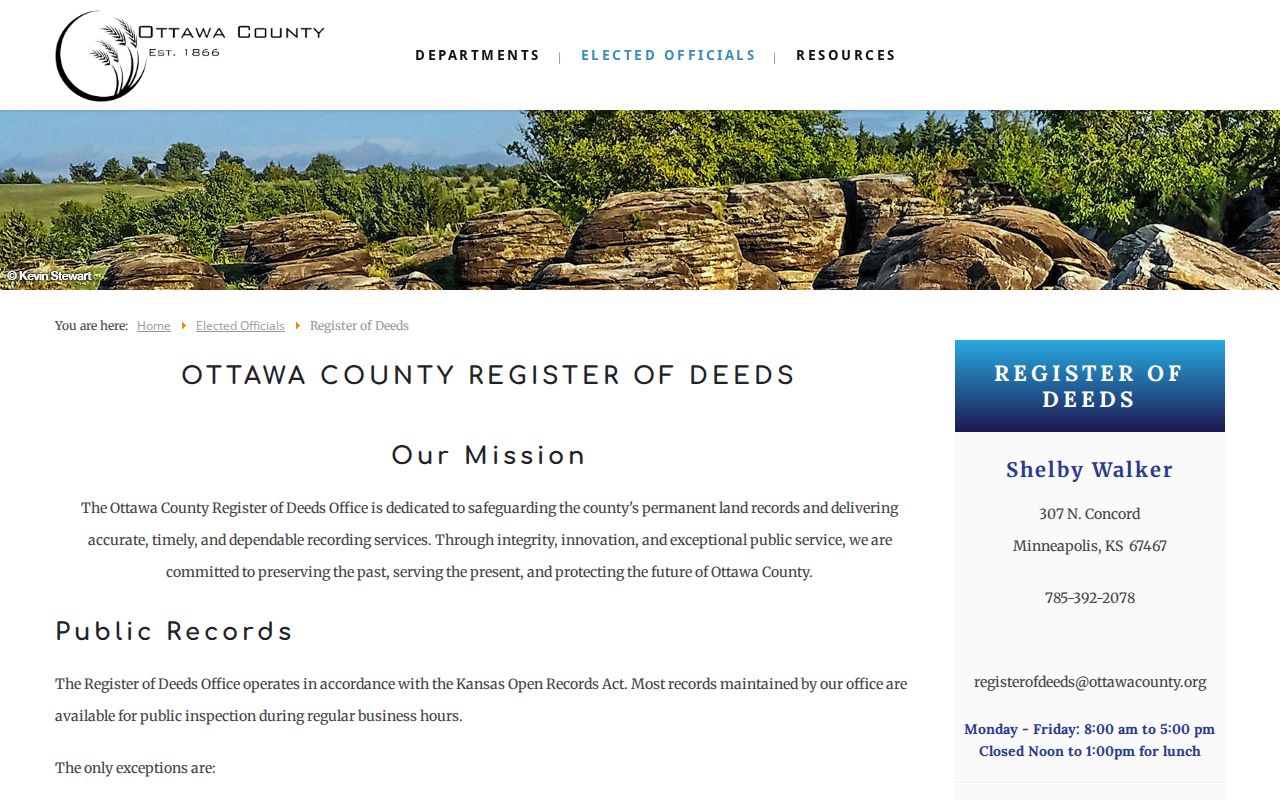
The official recorder page lists the county's named access routes without setting any online cutoff of its own.
Tapestry Access for Ottawa Deeds
Occasional deed research has one easy online route. Tapestry's land-record entry point lets you search Ottawa County deed records by name, paying only for what you view. Confirm the county's coverage first. The screen shows dates, parties and image charge. Instrument type appears there too. Treat the vendor's national help pages as general background only, since they prove nothing about Ottawa's earliest indexed year.
Never guess a book number or owner. When you need certification or the complete office record, request the exact instrument from the Register of Deeds. The Tapestry search screen is the vendor entry used by the county.
Check the county and date range in the live service. General vendor text cannot establish what Ottawa County coverage actually includes.
Ottawa Deeds and Legal Descriptions
Ottawa County uses two land-description patterns. Platted property appears by lot and block. It also names the subdivision and city. The Treasurer search fields and the recorder's document rules both reflect that split between platted and unplatted land. Copy the full description from each deed. Include any addition name or qualifier before deciding two instruments concern the same tract.
Named additions can matter. The tax list includes Minneapolis Original Town and many Sunrise additions, Bennington Original Town and Nelson additions, and Delphos Original Town with Eackers, Kiser and Stricklers additions. Splits, replats and corrections change wording. Search plats and corrective instruments when adjacent deeds do not match word for word.
Note: A postal address helps locate land, but the recorded legal description is the stronger chain-of-title key.
Ottawa County Grantor-Grantee Chain
The grantor conveys the stated interest. The grantee receives it. Start with a current assessment name and the exact legal description. Find the newest deed in which that party is grantee, read its grantor, then search that grantor backward as an earlier grantee. Dates and legal descriptions tie the sequence to the parcel, not to a same-name person.
- Copy the current roll name, CAMA key and complete legal description.
- Locate the latest deed naming that owner as grantee and verify the tract.
- Record the grantor, deed type, recording date and instrument or book-page reference.
- Search the grantor as an earlier grantee and repeat the land-description check.
- When online coverage ends, request the relevant index and deed books from the recorder.
- Grantor
- The party conveying the stated interest.
- Grantee
- The party receiving the stated interest.
- Chain of title
- The ordered sequence of conveyances affecting one tract.
- Book and page
- A volume-and-page reference used to retrieve a recorded item.
- Instrument number
- A unique recorder reference assigned to a filing.
A mortgage chain is not the ownership chain. Assignments and releases can confirm timing and lender interests, but the conveyance trail runs through deeds and other title-transfer instruments.
Ottawa County Recording Fees
Recording fees in Ottawa County follow the state baseline set by K.S.A. 28-115. For any deed, mortgage, or similar instrument filed on or after January 1, 2018, the first page costs $17. Each added page costs $13. Town-plat pages run $32 apiece. A release or assignment of a real-estate mortgage is $16. A certified instrument is $13.
The same statute sets $17 for federal or state tax-lien notices and releases. Material or service liens also run $17, and $12.50 covers a signature acknowledgment. Technology and distribution charges may also apply. Documents with missing printed signer or notary names, or poor legibility, can cost extra. Fees can change. Ask the county for a current total before you file or order copies.
Ottawa County Fraud Notifications
The recorder points landowners to Property Fraud Alert, a free subscription service. You pick a name. You get notified when something new records against it. Many people subscribe after a purchase or an estate transfer. Some sign up after a suspicious letter about their property. It is not title insurance. It also cannot block a document from being recorded.
If an alert arrives, pull the instrument. Check the grantor, grantee and legal description closely. Question the record with the recorder's office. Get legal help if validity is in doubt. A shared name can trigger an alert about someone else entirely. The tract details tell you whether it is really your deed.
Alert, not a guarantee. A recording notification flags a name match. It does not decide ownership, remove a fraudulent instrument or replace periodic record review.
Confidential Ottawa Recorder Records
Most Ottawa County land records are open. But not everything filed with a deed is public. Kansas Real Estate Sales Validation Questionnaires stay confidential. Military discharge records are restricted too. Sitting beside a recorded deed does not make these papers copyable public material.
Request the public instrument instead: the deed, recorded mortgage, release, plat or easement. Under the Kansas Open Records Act, the custodian can release open material. Exempt content can be withheld. A request goes smoothly when it names the instrument. Name the parties, the date and the copy form you want.
Historic Ottawa County Deed Trail
Ottawa County was established in 1860 and organized in 1866. Minneapolis carried the county-seat elections of 1866, 1870 and 1872. The courthouse standing today opened in 1956. That seat history matters for custody, since deed books followed the seat. The county records no courthouse fire and no lost deed books. Treat any claim of a records gap with doubt.
The 1902 Ottawa County plat book offers township landowner maps. It also includes town plats and a patrons' directory. It can point toward an owner or tract before modern parcel numbering. Confirm every later transfer in the deed index. The Kansas Historical Society's county-government microfilm page omits Ottawa County. This limits one finding aid but proves nothing about surviving copies. The recorder still holds the earliest book and index.
Note: Ask for a specific deed, mortgage, plat or miscellaneous book with a date range. Request that instead of all historic land records.
Order an Ottawa County Deed
Start with the details. Gather party names, recording date, instrument type, and any book-page or instrument number from Tapestry, Laredo or a prior document. Then ask the Register of Deeds about the image. Find out whether it is online and whether you need a plain or certified copy. A certified copy carries the custodian's authentication. It is not a title opinion.
You can visit the courthouse counter during office hours. You can also contact the Register of Deeds through its county page to confirm availability and cost. A third option is mailing a focused KORA request. For older records, ask which index leads to the volume. Also ask whether that volume is paper, scanned or held some other way. Keep the receipt and citation with your copy.
Recorded, not guaranteed. Ottawa County deed records show what reached the recorder. They do not resolve unrecorded interests or provide a legal opinion on clear title.