
Trace Ottawa County Former Owners Transfer by Transfer
Every chain of Ottawa County former owners begins at the end. Take the latest deed first. Find its grantor. Then locate the earlier deed where that grantor took title as grantee, pulling every name, date, and book reference from the recorded instrument itself rather than a guessed example.
| Transfer point | Grantor to grantee | Instrument clue | Land match |
|---|---|---|---|
| Current conveyance | Prior owner to current grantee | Latest deed date and document or book/page | Full legal description |
| One step back | Earlier owner to the latest grantor | Earlier warranty, quitclaim, or fiduciary deed | Same lot, block, tract, or parent parcel |
| Changed parcel | Parent-tract owner to later parties | Plat, replat, correction, or boundary instrument | Predecessor description |
| Historic lead | Named landholder to later deed party | 1902 plat or dated public notice | Township, section, town plat, or addition |
Write each name in its role. A grantor conveyed; a grantee received. Mortgage parties, lien claimants, and taxpayers did not necessarily hold the parcel in fee simple.
Go Back Through Ottawa County's Grantor-Grantee Chain
The Ottawa County Register of Deeds safeguards the county's permanent land records and offers Laredo Anywhere and Tapestry for online access. No Ottawa-specific index start year is published. No image cutoff is stated either. Use the online source while it returns the deed you need, then turn to an office request once the chain reaches records the vendor does not cover.
- Copy the current grantee, deed date, document or book/page reference, and legal description.
- Read the current deed's grantor as the first candidate among the previous owners.
- Search that grantor as an earlier grantee, with spelling variants and a date before the current transfer.
- Compare the legal description, acreage, subdivision, lot and block, or section, township and range.
- Repeat until an index gap, parcel split, probate event, foreclosure, or original grant changes the route.
- Grantor
- The party conveying the interest described in an instrument.
- Grantee
- The party receiving that interest.
- Chain of title
- The ordered set of instruments that connects ownership through time.
- Reverse index
- An index organized to help search one party role, often grantor or grantee.
- Warranty versus quitclaim
- Different deed forms whose legal effect must be read from the instrument, not guessed from the title.
Use Ottawa County Legal Descriptions to Hold the Chain Together
Names alone can mislead. Platted Ottawa County land uses lot, block, subdivision, and city, while rural deeds lean on section, township, range, and sometimes metes-and-bounds text. Preserve every qualifier. Compare the same description across each transfer.
The Treasurer's search also exposes subdivision, lot and block, section, township and range, plus segmented CAMA fields. A CAMA number helps with today's account, but the legal description is the better bridge when a former owner predates a parcel split or renumbering. A later deed may name only a new lot. Search its parent tract instead.
Note: Keep leading zeros and the Treasurer's CAMA segment breaks, because Ottawa County publishes no decoding legend for those positions.
Separate Ottawa County Deeds from Encumbrance Records
A recorder search can return mortgages, assignments, releases, tax liens, judgments, lis pendens, easements, covenants, and affidavits beside the deeds. Plats appear there too. Encumbrances explain a parcel's story. They do not all add a former owner. A mortgage assignment follows a lender's interest rather than title.
Note the instrument type before any name lands on the ownership timeline. Warranty deeds, quitclaim deeds, executor or administrator deeds, sheriff's deeds, trustee deeds, and beneficiary instruments may belong in the chain. Corrective deeds may belong there too. Releases and satisfactions usually clear an encumbrance instead.
Follow Ottawa County Estates and Court-Ordered Transfers
A tidy grantor-to-grantee run can stop cold. Owners die. Courts order transfers. Hunt for an executor or administrator deed, survivorship affidavit, transfer-on-death instrument, probate property determination, sheriff's deed, trustee deed, or related court order. The public deed or probate order may explain the ownership step even when a vital certificate is restricted.
Ottawa County sits in Kansas's 28th Judicial District. The statewide Kansas CaseSearch can supply current case details. The local District Court Clerk is the route for an actual available file. Scope the case to Ottawa County and confirm its disposition, since a lis pendens or complaint never proved a foreclosure reached a deed.
The Ottawa County Online Start Year Remains Unpublished
The county recorder page states no earliest searchable grantor-grantee year. No first imaged book is named. Tapestry's general help cannot settle Ottawa County coverage either. So ask directly. Request the earliest online index, image availability, and the paper or book run covering your date.
The office keeps permanent land records open during regular business hours, subject to lawful exceptions. Ask by party, approximate year, book type, and legal description. Keep the request tight. A named deed book or index is workable. Asking staff to trace every former owner amounts to a title search. The office says it does not perform that.
Coverage limit. No verified Ottawa County online cutoff year was found. Continue in office-held indexes and deed books rather than inventing a starting date.
Bridge Former Ottawa County Owners with the 1902 Plat Book
The 1902 Plat book of Ottawa County is the earliest digitized ownership map available for the county. Its 43 pages hold township maps and landowner names. Town plats and a patrons' directory fill out the volume.
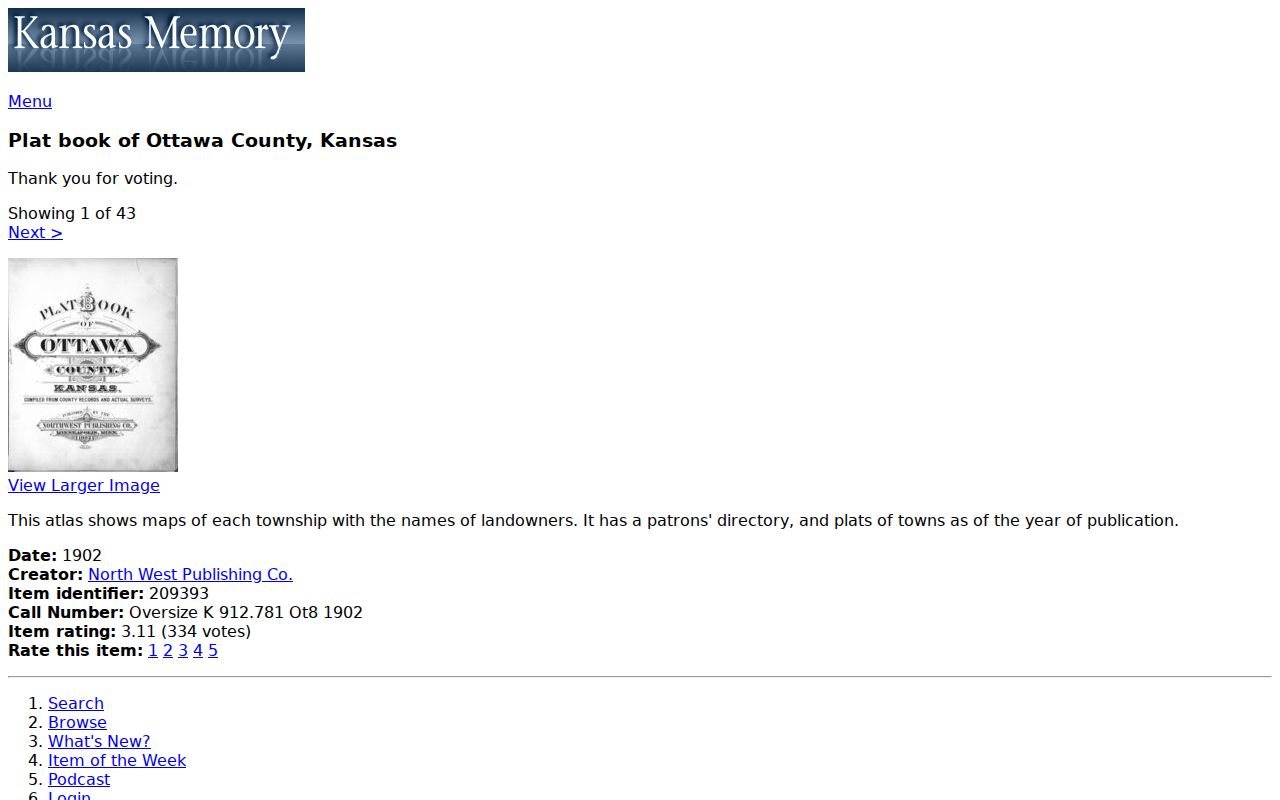
Treat the map as a bridge. Pair a landowner name with a township as a hypothesis, then prove the transition with the recorder's deeds. The plat is no current survey or title record.
Newspapers Supply Ottawa County Prior-Owner Clues
The Kansas Historical Society newspaper search lists 204 Ottawa County entries. Local runs include the Delphos Republican, Bennington Star, Bennington Journal, Bennington News, Minneapolis Better Way, and Minneapolis Messenger. The Ottawa County Democrat rounds out the list. Their pages reveal probate notices, foreclosure steps, sheriff sales, and city lot references.
A notice is only a clue. It never proves a completed transfer. Capture the paper title, date, page or reel, names, and land terms. Then locate the deed or final court record. Search historic place names and additions exactly as printed. An old notice rarely uses a modern street address.
When Former Ottawa County Owners Leave the Web
The KSHS county-government microfilm list skips Ottawa County entirely. That gap does not close the door. Microfilm may still sit in other repositories. The recorder stays the first stop for custody of deed books and indexes. The State Archives research room can help track down supporting collections. So can Kansas Memory, the FamilySearch catalog, and the Ottawa County Historical Society.
The county itself dates to 1860 and organized in 1866. Minneapolis won the county seat for good after votes in 1866, 1870, and 1872. No courthouse fire or destroyed deed book appears in the record. Treat a supposed records gap from loss as a myth. Ask the recorder directly about which book series survive.
Note: Archive directories, census lines, and plat-book names can point you toward a deed request. Only the recorded instrument proves ownership.
Set the Time and Proof Limits for Ottawa County Former Owners
Any former-owner list is only as sound as the instruments behind it. At every step, write down the transfer date. Note the party roles. Record the deed type, the book and page or document number, and the exact legal description. Flag uncertain branches early. Repeated names invite mistakes. So does an entity that changed form or a tract that was split.
You can also work at the Register of Deeds counter at 307 N. Concord in Minneapolis. A precise Kansas Open Records Act request for an existing public record works too. The office may charge lawful copy or certification fees. It may also ask for enough detail to locate the item. For a legal title opinion, rely on a licensed title company or an attorney.
Lawful use. Reconstruct previous owners for house history, estate work, title diligence, or research. Never use a historical chain to harass or target a living person.