
Compare Ottawa County Property Value Types
A smart valuation check labels the type, year, and source beside every number. The first two figures come from mass appraisal and Kansas assessment rules. The third belongs to a single transaction, and you may need a deed or parcel result that actually displays the field before you can use it.
| Value type | Meaning in Ottawa County | Official record source |
|---|---|---|
| Appraised or fair-market value | The Appraiser's estimate of market value as of the assessment date | Appraiser roll or parcel card |
| Assessed value | Appraised value multiplied by the Kansas rate for the property's class | Assessment and tax records |
| Last sale or consideration | A prior transaction amount when an available public record actually shows it | Deed or parcel result, subject to field availability |
| Taxable amount | A figure affected by classification and any applicable treatment shown on the record | County assessment and tax system |
Not every search result shows everything. Treat a sale price, land and improvement split, value history, or exemption flag as absent until the returned screen confirms that field for your Ottawa County parcel.
Ottawa County Appraised Value Starts the Formula
The Ottawa County Appraiser discovers, lists, and appraises taxable real and personal property. Every parcel receives a new value each year. The office also physically verifies parcels once every six years. Those practices support the assessment roll, but they are not an individual sale appraisal. The Kansas Department of Revenue puts the relationship plainly. Fair-market or appraised value multiplied by the assessment rate equals assessed value. Assessed value then multiplies by the mill levy. It divides by 1,000 to produce the tax. The tax bill sits downstream from value and rate.
Note: A change in tax can reflect a value, classification, or levy change. The bill alone does not explain the appraisal.
Kansas Rates Change an Ottawa County Assessed Value
Property class is the bridge between appraised and assessed figures. Kansas Department of Revenue materials set residential property at 11.5 percent, commercial and industrial property at 25 percent, vacant lots at 12 percent, and agricultural land at 30 percent of economic-use value. Other classes carry their own rates under the same formula.
| Class example | Assessment treatment documented by KDOR |
|---|---|
| Residential | 11.5 percent of appraised value |
| Commercial or industrial | 25 percent of appraised value |
| Vacant lot | 12 percent of appraised value |
| Agricultural land | 30 percent of economic-use value |
That is why two Ottawa County parcels with identical appraised figures can end up with different assessed values. Confirm the classification and use actually shown for the parcel. Never apply a rate based on how a property looks.
Estimate the Ottawa County Value Recorded for a Parcel
The Ottawa County Appraiser portal advertises public access, though the public-user continuation does not always complete for outside visitors. The Treasurer search offers a reliable alternative for locating the account by address, owner, CAMA number, subdivision, or legal-description fields.
- Enter the exact street number and street name in the Ottawa County tax search.
- When needed, restrict the tax type to Real Estate and add the subdivision or rural section data.
- Copy the CAMA or tax ID and legal description from the matching result.
- Continue to the Appraiser parcel record or request the parcel card, then note each value and its year.
- Apply no assessment rate until the record confirms the property class.
- Appraised value
- The county's mass-appraisal estimate of fair-market value for assessment.
- Assessed value
- The figure produced after the statutory class rate is applied.
- Assessment rate
- The percentage assigned by Kansas law to a property class.
- Sale consideration
- A transaction amount or term that may appear in a deed-related record.
- Reassessment
- The recurring process of establishing a new value for the roll.
Ottawa County's 2026 Market Study Is Not a Parcel Forecast
The Appraiser's January 1, 2026 market study reports broad changes from 2025. Houses built before 1945 increased 5 percent overall. Houses built after 1945 increased 7 percent. Commercial property rose 4 percent, while vacant lots stayed stable. The office cites location, age, style, condition, and comparable sales among its influences. Keep in mind these are county assessment-study trends. They do not say every older home rose by the same amount. They guarantee no sale price. One parcel's condition, class, improvements, land use, and local evidence can produce a different result. The official Appraiser page presents the county's own account of that assessment context.
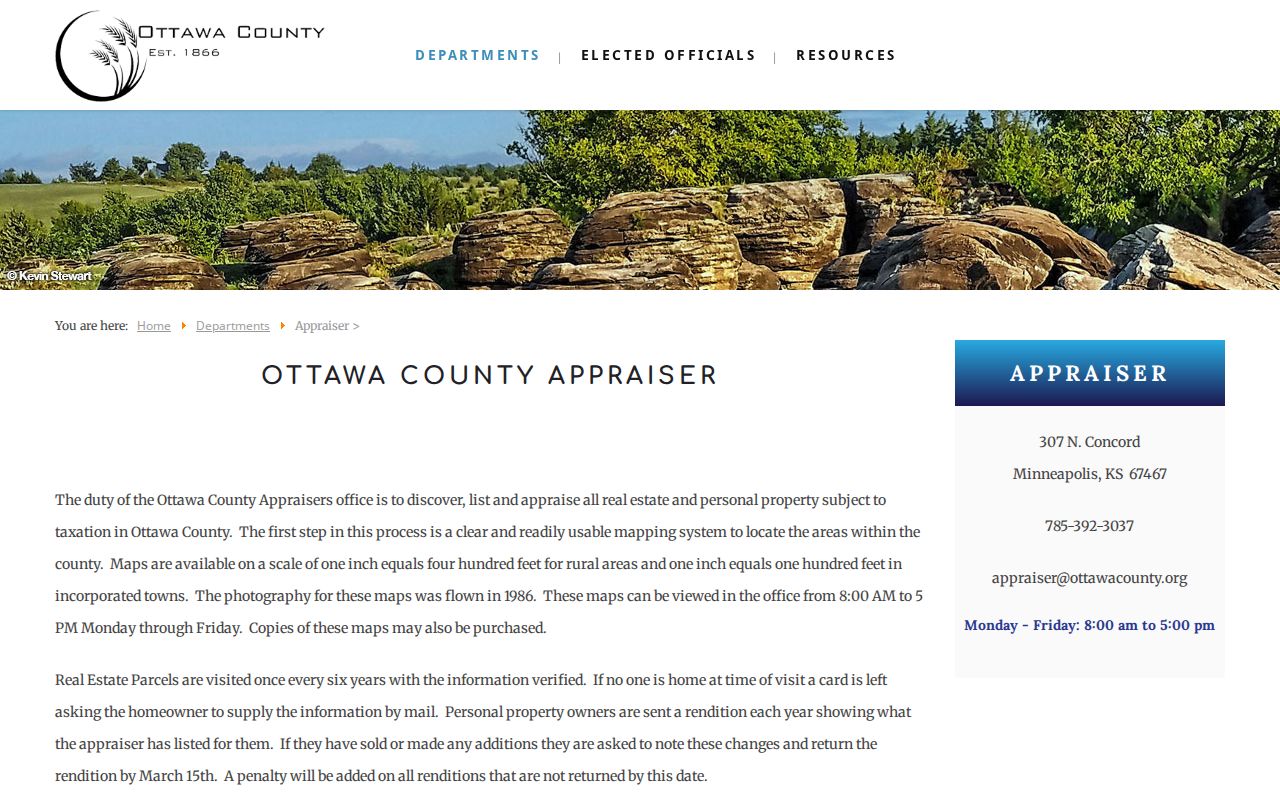
Read the study alongside the parcel's own notice and record year. It is not a stand-alone estimate.
Ottawa County Sale Price Belongs to a Different Record
A sale price records what parties exchanged in one particular transaction. The appraised value, by contrast, is a mass-appraisal figure built for tax administration. Time, financing, related-party terms, personal property, repairs, and market conditions all matter. Any of them can keep the two numbers apart. The Register of Deeds records conveyances, but Kansas Real Estate Sales Validation Questionnaires are confidential. No consideration amount is guaranteed in an Ottawa County online result. Use the latest recorded deed and the parcel record carefully. Read them only for the fields they actually show. For deed access, the Ottawa County Register of Deeds page names Laredo Anywhere and Tapestry. The office also provides in-person access during regular business hours.
Agricultural Ottawa County Value Uses Economic Use
Kansas treats agricultural land differently from a simple residential market comparison. The documented rate is 30 percent of economic-use value. A nearby home sale is a poor shortcut. A vacant-lot asking price is too. Both make bad shortcuts for an agricultural assessed value. Check the parcel's actual classification, land use, and valuation record instead. Rural legal descriptions in Ottawa County often use section, township, and range. So the right tract can be hard to identify by mailing address alone. Preserve CAMA segments and the full deed description.
Mill Levies Do Not Redefine Ottawa County Property Value
A mill levy converts assessed value into tax. It is not another estimate of what the land is worth. The Ottawa County Clerk posts levy sheets from 2014 through 2025, and taxing districts can make the final bill differ across parcels with similar values. The official levy-sheet archive helps when you need to explain the tax calculation. A full bill lookup, due dates, delinquency, and protest route belong on the Ottawa County property tax records page. The key point here is simpler: levy math happens after assessment, not before it.
Ottawa County Value Evidence Has a Date
Both county databases carry refresh stamps. The Treasurer portal shows September 7, 2026, and the Appraiser landing page shows September 4, 2026. Those dates mark when each database was updated. They do not tell you when any parcel fact was actually measured. A value in Ottawa County property records is only as current as the roll year behind it, so note that year, your access date, and any valuation date beside every number you copy down.
Valuation notices go out around April 1 each year. An owner then has 30 days to appeal. That appeal process addresses the appraised value itself. It never converts an assessment into a private appraisal, and it cannot set a fresh sale price for the parcel.
Note: Use the date printed on the parcel notice, because a portal update stamp is not the effective date of every value.
What an Ottawa County Property Value Cannot Prove
No Ottawa County assessment can see behind walls. It cannot settle a title dispute or fix a boundary. It certainly cannot promise what a buyer will offer. Mass appraisal works by comparing many parcels with standardized data, which is efficient but broad. A licensed appraisal studies one property under professional standards. A survey and a title examination answer the questions an assessment leaves open.
Sometimes the public portal lacks the fields you need. Request the parcel card instead. The Appraiser sits at 307 N. Concord in Minneapolis, or call 785-392-3037. Under the Kansas Open Records Act, a custodian may require a written request and charge actual lawful costs, and the office is not generally obligated to create a new analysis for you.
Value is not price. Ottawa County assessed value is used in taxation and is not what a property will sell for. It is not an individual appraisal.
The Kansas Department of Revenue's property-tax formula page shows how appraised value, assessed value, and the levy relate.
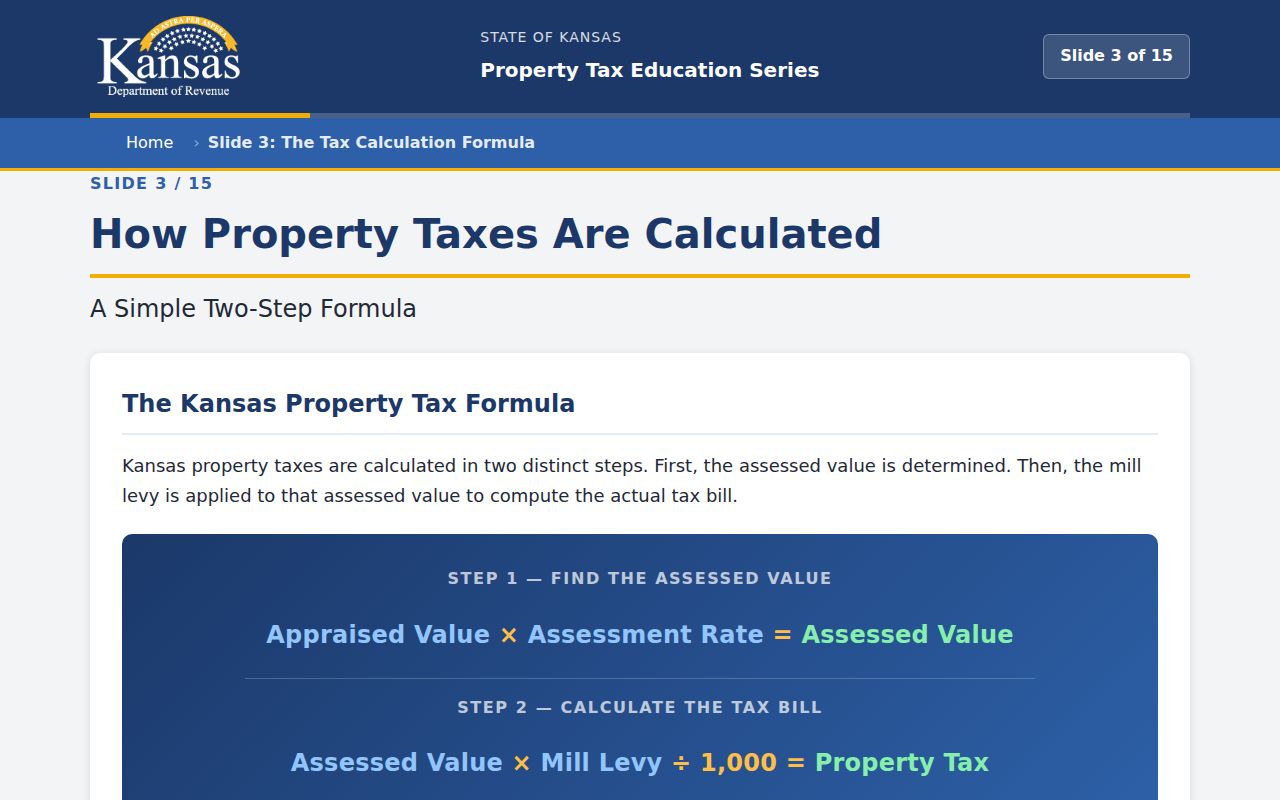
The state diagram links the figures without treating them as interchangeable. That distinction is the central rule for reading any county value record.